AI Interactions – Bringing Bhangra to Life Through Movement, Memory and AI
Running from April to July 2025 AI Interactions brought together a diverse team of collaborators, including East London Dance, Alexander Whitley Dance Company, London College of Fashion, UCL and UEL – spanning expertise in design, technology, education, and community engagement – each playing key roles in research, technical development, design and community engagement.
This collaborative project explored the potential of movement-based Artificial Intelligence to transform live performance and participatory experience. Focused on social dance, the project investigates how AI can support intergenerational exchange, cultural expression, and embodied communication, while enhancing well-being and fostering a deeper public understanding of AI technologies.
This project began with a simple question: what if technology could help people not just see a dance, but feel it? We set out to explore how visual and movement-based AI could deepen cultural connection—capturing the rhythm, energy, and joy of a social dance style and placing it directly into people’s hands (and bodies).
We chose Bhangra because of its powerful presence in east London, where Punjabi, Bangladeshi, and Indian communities have shaped local culture for generations. Bhangra isn’t just choreography—it’s identity, memory, and collective celebration. By focusing on one culturally rooted form, we aimed to show how AI can honour tradition rather than dilute it.
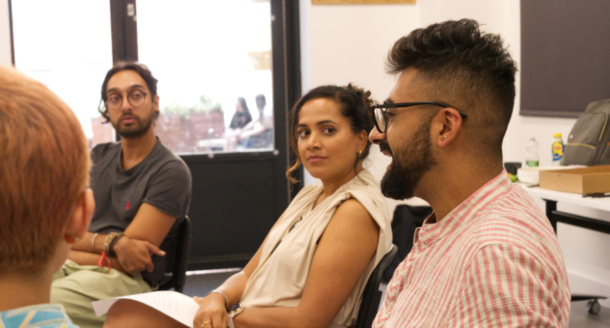
The process was community-led from day one. Bhangra artist Vinay Jobranputra helped us codify movements, and community members guided us on lived experience, costume, and concerns around representation. Their input shaped everything—from motion capture to Generative AI–designed avatar costumes. Transparency and cultural integrity weren’t add-ons; they were the foundation.
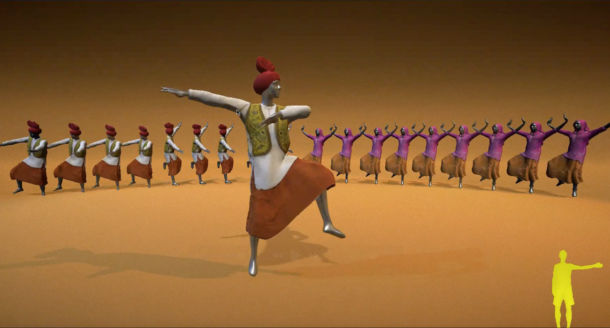
We built a prototype that invited people to try the movements, play with the tech, and explore together. Across the testing groups—from lifelong Bhangra dancers to students and families—the response was the same: joy, curiosity, connection. People experimented, laughed, even hugged each other to see if the avatars responded. The tech didn’t replace the social energy of the dance—it amplified it.
What we learned is powerful: when technology is shaped by the community it hopes to serve, it can open new pathways to movement, memory, and wellbeing. And when dancers, technologists, artists, and community members create together, the result is not only innovative—but profoundly human.
AI Interactions was supported by UCL and Loughborough University’s Creative Experience Futures Labs programme


